
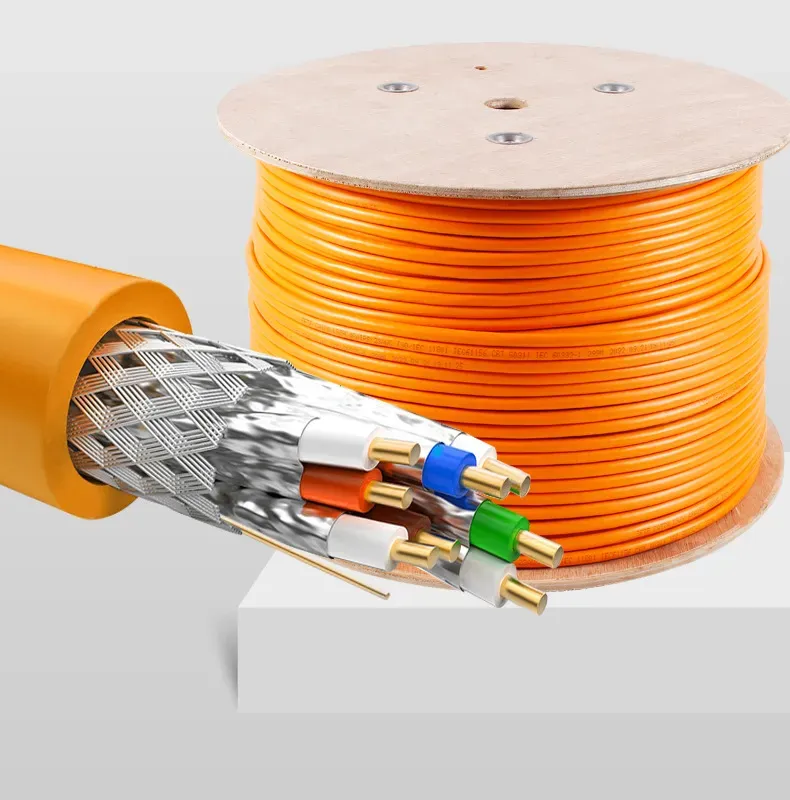
When you shop for Ethernet cables, what do you look at first? The category — Cat5e, Cat6, Cat6a? The price? The color? The length?If you're like most buyers, you probably assume all Ethernet cables are essentially the same on the inside. You couldn't be more wrong.The two most overlooked factors in Ethernet cable performance are:
1.The metal material of the conductor — pure copper vs. copper-clad aluminum (CCA)
2.The thickness of the conductor — AWG gauge (23 AWG vs. 24 AWG vs. 26–28 AWG)
These two factors determine everything: signal quality, maximum distance, Power over Ethernet (PoE) safety, heat generation, durability, and long-term reliability. Yet most buyers never check them.Let's break it down.
Part 1: Pure Copper vs. CCA
What Is Pure Copper Cable?
A pure copper Ethernet cable uses solid bare copper as the conductor material. Copper has been the gold standard for electrical wiring for over a century — and for good reason.
Key advantages of pure copper:
-Excellent conductivity — lowest electrical resistance among common conductor metals
-Superior signal integrity — less attenuation (signal loss) over distance
-Safe for PoE — handles power delivery without excessive heat buildup
-Durable and flexible — resists breakage during installation and over time
-TIA/EIA compliant — meets structured cabling standards for commercial installations
What Is CCA (Copper-Clad Aluminum) Cable?
CCA cables use an aluminum core coated with a thin layer of copper. They look like copper on the outside, but the performance is dramatically different.
The problems with CCA:
-~40–50% higher electrical resistance than pure copper of the same gauge
-Higher signal loss over distance — performance degrades faster
-PoE fire hazard — higher resistance generates excessive heat, which can melt the jacket or even start a fire
-Brittle and prone to breakage — aluminum is more fragile than copper; micro-fractures can develop during bending, causing intermittent connection issues that are nearly impossible to diagnose once the cable is inside a wall
-Not compliant with TIA/EIA standards — most CCA cables fail to meet industry cabling specifications
The Resistance Numbers Don't LieLet's look at the math. At 20°C, the resistivity of copper is 1.72 × 10⁻⁸ Ω·m, while aluminum is 2.65 × 10⁻⁸ Ω·m — that's 54% higher resistance for the same wire size.For a 100-meter, 24 AWG conductor:
-Pure copper: ~8.4 ohms
-CCA (10% copper cladding): ~12.3 ohms — 46% more resistance
This means more voltage drop, more heat, and more signal degradation. On a short cable run, the difference might be hidden. But under PoE load or over longer distances, it becomes a critical failure point.
The Verdict on CCA
Never use CCA cables for:
-In-wall or in-ceiling installations
-PoE devices (IP cameras, VoIP phones, wireless access points)
-Runs longer than 30 meters
-Any commercial or enterprise environment requiring code compliance
Always choose 100% pure copper for reliability, safety, and long-term value.
Part 2: AWG Gauge — Why Thickness Matters
AWG (American Wire Gauge) measures the thickness of the copper conductor inside the cable. Here's the counterintuitive part: a lower AWG number means a thicker wire.
AWG Comparison Table
A 23 AWG conductor has about 17% more cross-sectional area than 24 AWG, which directly translates to lower DC resistance, less voltage drop, and less heat in PoE bundles.
Why "Cat6 24 AWG" Is a Red Flag for Smart Buyers
You'll often see "Cat6 24 AWG" on marketplaces. It can pass Cat6 testing over short distances, but here's what experienced buyers know:
-True Cat6 / Cat6a permanent cable is normally 23 AWG solid copper
-24 AWG Cat6 leaves less margin on 90 m runs, bends, temperature rise, and PoE
-In bundled PoE installations, 23 AWG runs visibly cooler than 24 AWG
-If the cable says Cat6 + CCA + 24 AWG → that's a triple compromise: wrong material, thin conductor, non-compliant
Buyer rule of thumb:
Cat5e → 24 AWG solid copper ✅
Cat6 permanent link → 23 AWG solid copper ✅
Cat6a → 23 AWG (sometimes 22 AWG) ✅
Cat6 "24 AWG" → okay for short patch cords, questionable for in-wall 100 m PoE
How Gauge Affects Performance
1. Signal Integrity
Thicker wires (23–24 AWG) have lower electrical resistance, which means less signal degradation over distance. A 23 AWG Cat6a cable can reliably carry 10 Gigabit Ethernet up to 100 meters. A 28 AWG "slim" cable? Only about 10–15 meters.
2. Power over Ethernet (PoE)
PoE delivers power alongside data through the same cable. Thicker conductors handle the current with less resistance, generating less heat. For PoE++ (60W or 90W) applications, 23 AWG is the safe choice. Thin 28 AWG cables can overheat under high PoE loads.
3. Heat Management
Thicker cables produce less heat per meter. However, in dense server racks, thinner cables allow better airflow, which can actually improve overall thermal management in that specific scenario.
4. Flexibility
Thinner cables (26–28 AWG) are more flexible and easier to route through tight spaces and patch panels. This is the main reason to choose slim cables — but only for short runs.
PoE Application Guide by AWG
A 23 AWG pure copper cable typically has about 20% lower DC resistance than 24 AWG pure copper of the same length. That shows up as:
-More volts at the camera / access point
-Less heat in the cable bundle
-Fewer random reboots
-Longer cable life
⚠️ CCA doesn't fix this: even "CCA 23 AWG" still has an aluminum core with high resistance. For PoE, always pure copper, preferably 23 AWG.
Part 3: How to Spot a Quality Ethernet Cable — A Quick Checklist
When sourcing Ethernet cables for your home, office, or business, use this checklist:
✅ 1. Check the Conductor Material
Look for "100% pure bare copper" or "solid copper" on the product specification. If it says "CCA," "copper-clad aluminum," or doesn't specify the material — walk away.
✅ 2. Check the AWG Rating
A quality Cat6 permanent cable should be 23 AWG. Some budget cables use 24 AWG or even 26 AWG and still claim "Cat6" — but they won't perform to spec over distance.
✅ 3. Look for Certification
Genuine Category cables are tested to TIA/EIA-568 standards. Look for Fluke-tested or UL-listed certifications.
✅ 4. Check the Copper Color
Cut a short piece of the cable and sand the end. Pure copper is copper-colored all the way through. CCA will show a silver/aluminum core under the thin copper coating.
✅ 5. Bend Test
Pure copper is flexible and resilient. CCA feels stiffer and can snap or kink more easily when bent sharply.
Part 4: Quick Selection Guide by Project
Part 5: Why This Matters for Your Business
If you're running a network — whether it's a home office, a warehouse, a data center, or a smart building — the cable is the foundation.A cheap CCA cable with thin 28 AWG conductors might save you $20 today. But it could cost you hundreds in:
Downtime from intermittent connection failures
Device damage from PoE overheating
Re-cabling labor when the cheap cable fails in 2 years
Fire risk in PoE installations
Pure copper, 23–24 AWG Ethernet cables are the industry standard for a reason. They deliver consistent performance, meet safety codes, and last 10+ years.
Why Choose JSJ for Your Ethernet Cable Supply?
At JSJ , we specialize in manufacturing high-quality Ethernet cables for global distribution. Every cable we produce:
✅ 100% pure bare copper conductors — no CCA, no shortcuts
✅ Full AWG compliance — 24 AWG for Cat5e, 23 AWG for Cat6/Cat6a
✅ TIA/EIA-568 certified — Fluke-tested for performance
✅ Wide range — Cat5e, Cat6, Cat6a, Cat8, shielded & unshielded
✅ OEM/ODM available — custom lengths, colors, packaging, and branding
✅ Bulk & retail packaging — for distributors, installers, and e-commerce
Contact us today for wholesale pricing, samples, and technical specifications.
Email: fengjun@jsjinfotech.com