
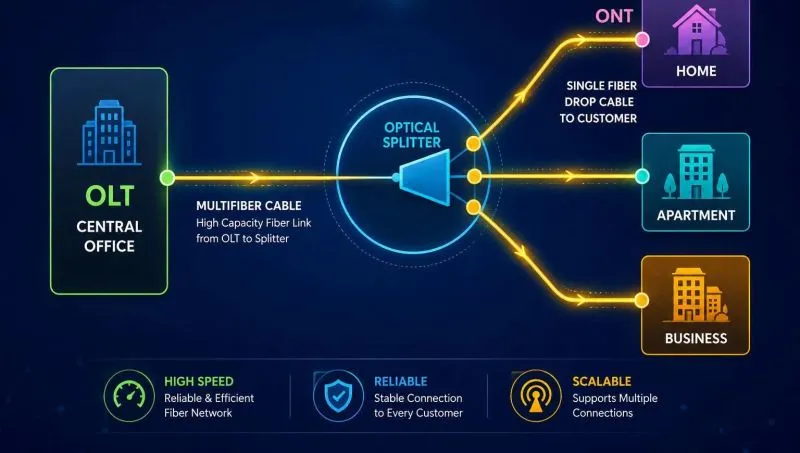
Fiber-to-the-Home (FTTH) and Fiber-to-the-x (FTTx) deployments are accelerating worldwide as demand for high-speed broadband continues to surge. Whether you're a network engineer, a project manager, or a telecom contractor, one of the most critical decisions you'll face is selecting the right optical fiber cable for your deployment.
Choose wrong, and you risk signal loss, higher installation costs, or premature network failure. Choose right, and you build a future-proof infrastructure that delivers reliable performance for decades.Here's a practical guide to making that choice.
1. Understand FTTH Deployment Scenario First
Before diving into fiber types, ask yourself: Where is this cable going?
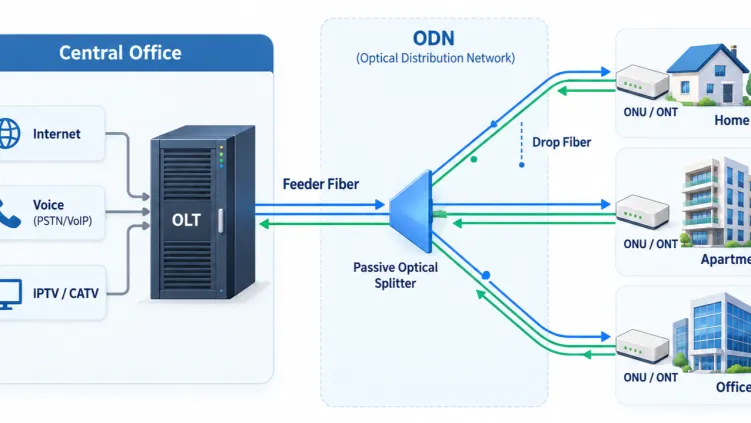
FTTx networks typically involve three distinct segments:
Feeder (Backbone) Cables — from the central office (CO) to the distribution point. These run long distances and often carry high fiber counts.
Distribution Cables — from the distribution point to the curb or building entrance. These branch out and may be exposed to harsher environments.
Drop Cables — the final leg into the subscriber's home or office. These need to be flexible, durable, and easy to terminate.Each segment has different requirements. A one-size-fits-all approach rarely works.
2. Single-Mode vs. Multi-Mode
For FTTH and FTTx, single-mode fiber (SMF) is the industry standard — and for good reason.
| Feature | Single-Mode (OS2) | Multi-Mode (OM3/OM4/OM5) |
|---|---|---|
| Core Size | 9 µm | 50 µm or 62.5 µm |
| Distance | Up to 40+ km | Typically ≤ 550 m |
| Bandwidth | Virtually unlimited | Limited by modal dispersion |
| Cost per meter | Lower (for long haul) | Lower for short runs |
| Typical Use | FTTH, FTTx, WAN | Data centers, LAN |
Verdict: For any FTTx project that extends beyond a few hundred meters — which is almost all of them — go with G.652.D single-mode fiber. It's the most widely deployed, best-supported, and most cost-effective choice for access networks.
💡 Pro tip: G.657.A1 or A2 (bend-insensitive single-mode fiber) is highly recommended for drop cables, especially in apartment buildings or tight conduit paths where bending is unavoidable.
3. Fiber Count
It's tempting to over-specify fiber counts "just in case." But higher counts mean larger cable diameters, heavier weight, and more complex splicing.
Here's a practical guideline:
-Drop cables (to a single home): 1 or 2 fibers (1 is often enough; 2 provides redundancy)
-Distribution cables (to a building or street cabinet): 4 to 24 fibers
-Feeder cables (back to the CO): 48 to 288 fibers, depending on subscriber density
Rule of thumb: Plan for 20–30% growth over your current needs, but don't double or triple the count unnecessarily. Fiber is cheap to deploy now but expensive to upgrade later — still, overbuilding by 5x is rarely justified.
4. Cable Construction: Match the Environment
FTTx cables come in several construction types. Choose based on where the cable will be installed:
| Environment | Recommended Cable Type | Key Features |
|---|---|---|
| Direct burial | Armored, double-jacketed | Water-blocking, high tensile strength |
| Inside the home | Bend-insensitive drop cable | Integrated messenger wire, UV-resistant |
| Underground (duct) | Loose-tube, gel-filled or dry-block | Fire-retardant, flexible, easy to connectorize |
| Aerial (pole to pole) | Self-supporting (figure-8 or ADSS) | Rodent-proof, crush-resistant |
| Indoor (riser/plenum) | Tight-buffered, OFNR/OFNP rated | Small bend radius, low friction jacket |
5. Connector Types
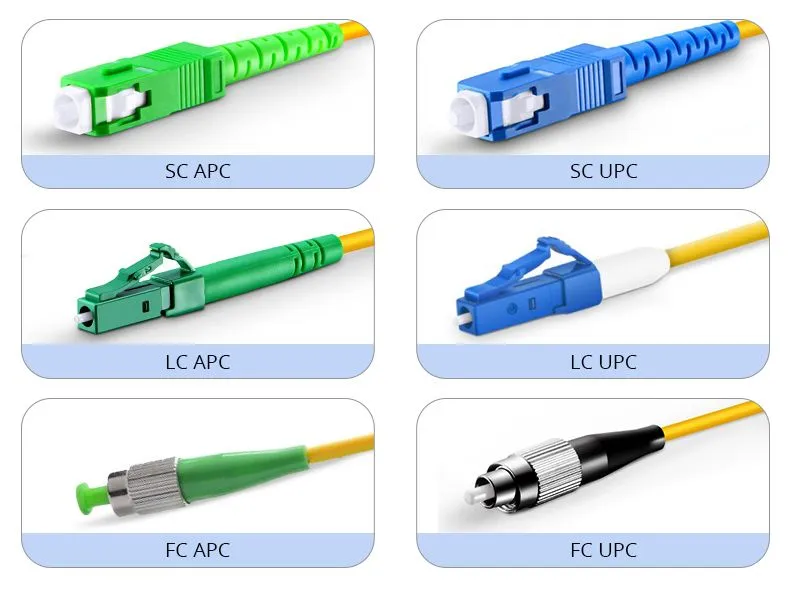
The fiber itself is only half the story. Connector choice directly impacts installation speed and long-term performance.For FTTH/FTTx, the most common connectors are:
SC/APC — The gold standard for FTTH. The angled polish (APC) minimizes back reflection, which is critical for PON (Passive Optical Network) systems.
LC — Compact form factor, common in OLTs and ONTs with high port density.
Pre-connectorized (pigtailed) cables — Increasingly popular for drop cables. They eliminate field splicing, reduce installation time, and lower the risk of contamination.
⚠️ Important: Never mix APC (green) and UPC (blue) connectors in the same link. They are physically incompatible and will cause high insertion loss.
6. Attenuation and Budget
Every FTTx project needs a link loss budget calculation. Here's a simplified version:
| Component | Typical Loss (per unit) |
|---|---|
| Fiber (G.652.D @ 1310 nm) | 0.35 dB/km |
| Fiber (G.652.D @ 1550 nm) | 0.22 dB/km |
| Splice (fusion) | 0.05–0.1 dB |
| Connector (mated pair) | 0.3–0.5 dB |
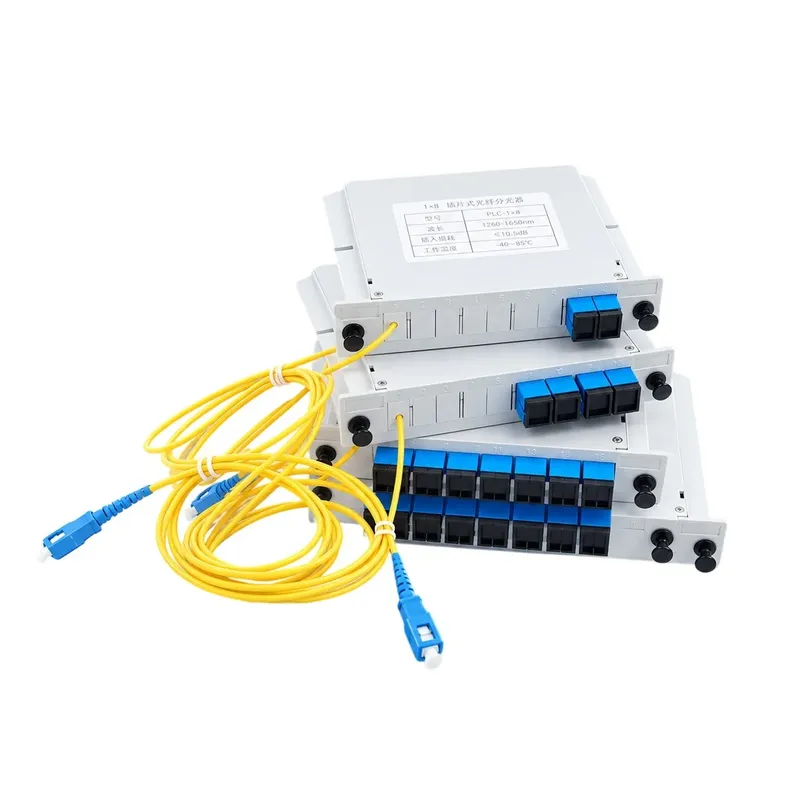
| Splitter (1:32) | ~16.5 dB |
Example: A 5 km link with 2 splices and 2 connector pairs at 1310 nm:
-Fiber loss: 5 × 0.35 = 1.75 dB
-Splice loss: 2 × 0.1 = 0.2 dB
-Connector loss: 2 × 0.5 = 1.0 dB
Total link loss: ~2.95 dB
Make sure your total loss stays well within the optical power budget of your transceivers (typically 28–32 dB for GPON/XGS-PON systems).
7. Future-Proofing
FTTH networks are expected to last 20–30 years. What seems like overkill today may become essential tomorrow.
Choose G.652.D as your baseline. It supports 10G, 25G, 50G, and even 100G per wavelength.
Consider G.657.A2 for drop cables. It's backward-compatible with G.652.D but offers superior bend performance — a lifesaver in tight residential spaces.
Don't ignore WDM readiness. Even if you're deploying GPON today, your fiber should support future DWDM or TWDM-PON upgrades.
The fiber itself is a small fraction of total project cost (often < 10%). Skimping on quality to save pennies per meter is a false economy.
8. Procurement Checklist
Before placing your order, run through this checklist:
-Fiber type: G.652.D (or G.657.A2 for drops)
-Fiber count: matched to current needs + 20–30% growth
-Cable construction: matched to installation environment
-Connector type: SC/APC for PON networks
-Attenuation: verified against link loss budget
-Certifications: Telcordia/GR-20, IEC 60794, RoHS
-Supplier: reputable, with consistent quality records
Final Thoughts
Choosing the right fiber for your FTTH or FTTx project doesn't have to be complicated. Stick with single-mode G.652.D as your backbone, use bend-insensitive G.657.A2 for drops, match your cable construction to the environment, and always calculate your loss budget before deployment.
The right fiber choice today means fewer truck rolls, lower maintenance costs, and happier subscribers tomorrow.
If you have any questions or you want to purchase fiber optic cables from China, please contact JSJ TECH, we will provide you one-stop solution.