
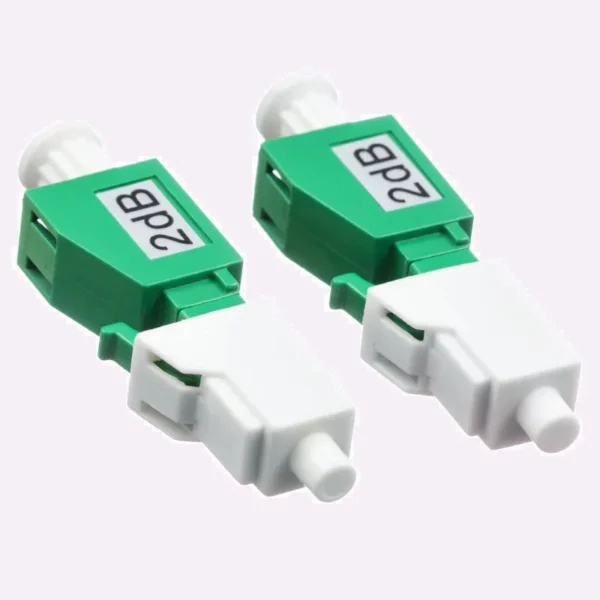




A fiber optic attenuator (also called an optical attenuator) is a passive device used to reduce the power level of an optical signal in a fiber optic transmission system. It is essential for preventing receiver saturation, balancing optical power across network links, and enabling accurate testing and measurement in both single-mode and multi-mode fiber networks.
Whether you are deploying a GPON access network, maintaining a DWDM backbone, or running sensitivity tests in a lab, the right optical attenuator ensures your signal stays within the optimal power range — protecting sensitive receivers and improving overall system reliability.
Types of Fiber Optic Attenuators
1. Fixed Optical Attenuators
Fixed attenuators provide a pre-set, non-adjustable attenuation value. They are the most common and cost-effective choice for routine deployments.
Common attenuation values: 1 dB, 2 dB, 3 dB, 5 dB, 10 dB, 15 dB, 20 dB, 25 dB, 30 dB
Connector Types and Polish Options
Connector interface : LC/FC/SC/ST
Polish Options: UPC/APC
Key specification:
- Attenuation accuracy: ±0.5 dB (1–10 dB), ±1.0 dB (11–15 dB), ±10% (16–30 dB)
- Return loss: ≥50 dB (UPC), ≥60 dB (APC)
- Operating wavelength: 1310/1550 nm


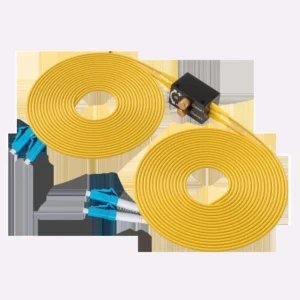
2. Variable Optical Attenuators
Attenuation range: 0–30 dB


Applications
- Telecommunications & Access Networks — GPON, XGS-PON, active Ethernet
- Data Centers — Power balancing in high-density fiber interconnects
- CATV / RFoG — Analog signal leveling with APC polish
- DWDM / EDFA Systems — Channel power equalization and gain flattening
- Test & Measurement — Receiver sensitivity testing, link margin verification, stress testing
- Laboratory & R&D — Controlled optical power for experimental setups
- Military & Industrial — Ruggedized environments requiring stable, repeatable attenuation
FAQ for Fiber Optic Attenuator
Q: Does a fixed attenuator’s insertion loss need to be calculated separately?
A: No. The labeled attenuation value (e.g., 10 dB) is the total insertion loss the device introduces. In a link budget, simply add this value along with connector and splice losses.
Q: Are optical attenuators wavelength-dependent?
A: Standard single-mode attenuators are designed for dual-window operation (1310/1550 nm) and work across 1260–1620 nm. Precision applications may require wavelength-specific calibration.
Q: Can I use a single-mode attenuator on a multi-mode link?
A: No. The core size mismatch (9 µm vs. 50/62.5 µm) will produce unpredictable and non-repeatable attenuation. Always match the mode type.
Q: What is the difference between UPC and APC attenuators?
A: UPC (Ultra Physical Contact) provides ≥50 dB return loss. APC (Angled Physical Contact) provides ≥60 dB return loss and is required for analog/RF applications. They are not interchangeable.


Reviews
There are no reviews yet.